
At a glance
On October 13, 2026, the Circular Action Alliance (CAA) published its 2027 SB 54 incentive values. The malus on virgin plastic rises to an estimated $100 per ton, the Tier 1 source reduction bonus rises to $500 per ton, and PCR bonuses are now set by plastic type. These values apply to 2027 packaging, first appear on January 2029 invoices, and still need CalRecycle approval.
Overview
California just put a clearer price on virgin plastic and a bigger reward on using less of it.
On October 13, 2026, the Circular Action Alliance (CAA), the organization running California's packaging law (SB 54), published its 2027 Incentive Mechanism Schedule. It replaces the illustrative numbers CAA shared in May. The key changes: virgin plastic now costs four times more than first estimated, and the main reward for cutting packaging more than doubled.
None of this changes your next two SB 54 invoices. But it does change the math on every packaging decision you make in 2027, because 2027 is the year that counts.
What are SB 54 bonuses and maluses?
SB 54 requires companies to cut the single-use plastic packaging they sell into California by 25% by 2032, compared with 2023 levels. To get there, CAA adjusts each company's fees up or down based on what's in their packaging.
- Malus (a surcharge): a penalty fee on every ton of virgin plastic, meaning plastic made from new fossil-based material. Every company selling plastic packaging into California pays it, whether or not they earn a bonus.
- Bonus (a credit): a credit against your SB 54 fees for packaging changes that move California toward its goals. There are three ways to earn one: using less plastic (source reduction), switching to reusable or refillable packaging, or using recycled plastic (post-consumer recycled, or PCR, content).
The SB 54 bonus and malus are linked. CAA says the malus will rise as more companies earn bonuses, so producers that keep using virgin plastic will pay more as competitors cut back.
What changed in CAA's 2027 incentive schedule since May?
Three key changes to know. All values are in dollars per ton of packaging, the unit CAA uses.
1. Virgin plastic costs 4x more than first estimated
The malus is now estimated at $100 per ton, about 5¢ per pound, up from $25 in May. CAA forecasts the malus at $150 per ton in 2028 and $200 per ton in 2029. Because the malus applies to all virgin plastic, it affects every producer selling plastic packaging into California.
2. Cutting packaging pays more than twice as much
The Tier 1 source reduction bonus jumped from $200 to $500 per ton. The Tier 1 bonus pays for each ton of plastic you cut between your 2026 and 2023 levels. The Tier 2 bonus, for each ton cut below 2023 levels, holds at $1,500 per ton. The reuse/refill bonus also holds, at $500 per ton. CAA forecasts all three bonuses rising in 2028 and 2029.
3. Recycled content is now rewarded by type of plastic
In May, the PCR bonus was organized by packaging format. Now it's organized by resin, the type of plastic. PET, PP and colored HDPE earn the most.
One catch for flexible packaging: May's rows for mono-material PE film ($1,000) and PP film ($1,200) are gone. Under any mapping, flexible PCR now earns less, and CAA hasn't yet said which row films fall under.
When will SB 54 bonuses and maluses appear on invoices?
The new values apply to packaging you sell in 2027, but they won't appear on an invoice until January 2029.
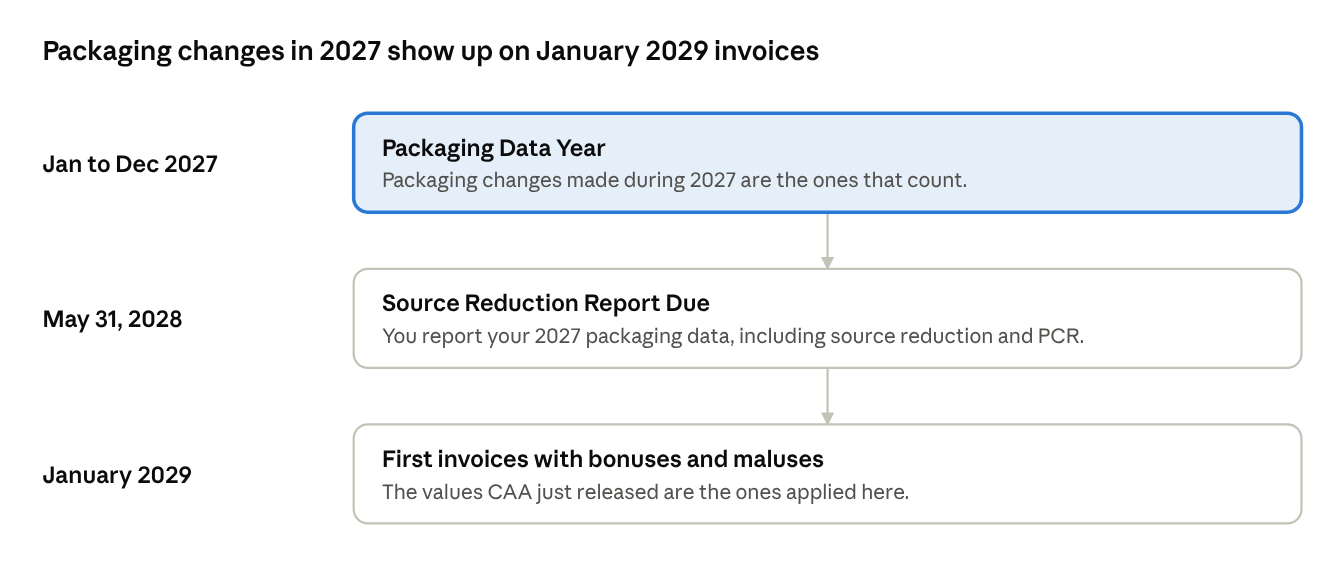
SB 54 bonus/malus timeline · 2027 supply
- January–December 2027: the first performance year. Packaging changes made during 2027 are the ones that count.
- May 31, 2028: producers report 2027 packaging data in their Source Reduction Report.
- January 2029: the first SB 54 invoices with bonuses and maluses applied.
Your 2027 and 2028 invoices cover base fees only, with no source reduction bonus or malus. In October 2027, CAA will publish values for 2028 packaging, which will appear on 2030 invoices.
How should producers prepare for 2027?
Packaging changes take time to design, source and roll out, and only changes made during 2027 count toward the first bonuses. If you want a bonus to land in 2029, the work starts now.
- Know your baseline. You can't earn a source reduction bonus without knowing how much plastic you sell into California today, by resin and format.
- Price your virgin plastic. At $100 a ton now and a forecast $200 by 2029, run the numbers on what cutting virgin plastic could save you.
- Find your quick wins. Lighter-weight packaging and higher PCR in PET or PP bottles and tubs are where the new values pay most.
- Keep your data audit-ready. Every bonus you claim in May 2028 has to be backed by 2027 records.
One caveat: these numbers aren't final. CAA can't commit to them until CalRecycle approves its program plan, expected by January 1, and CAA resets the values every October. Treat them as the best guide available, not a guarantee.
FAQ
Will my 2027 SB 54 invoice change? No. 2027 and 2028 invoices cover base fees only. Bonuses and maluses first appear on January 2029 invoices.
Do I pay the malus if I'm not claiming a bonus? Yes. The malus applies to all virgin plastic, whether or not you claim a bonus.
What does $100 a ton mean for my packaging? About 5¢ per pound of virgin plastic. A company selling 500 tons of virgin plastic packaging into California would owe roughly $50,000 in malus on 2027 supply.
Which recycled plastics earn the biggest bonus? PET and PP, at $500 per ton, followed by colored HDPE at $400.
What about flexible packaging? The dedicated film rows from May are gone, so flexible PCR earns less. CAA hasn't confirmed which resin row films fall under.
Are these numbers locked in? Not yet. They depend on CalRecycle approving CAA's program plan, expected by January 1, and CAA updates them every October.
Turn the new incentives into savings
The new values reward companies that move early. rePurpose handles your California reporting and builds your source reduction plan with you, so you know exactly where bonuses are within reach and what the malus will cost if you don't make changes.
Talk to our team to get your California reporting and source reduction planning done.
Source: Circular Action Alliance, 2027 Incentive Mechanism Schedule, published October 2026.
Related posts